
How to Choose a Material Handling Power Source: 7 Key Factors
Today’s lift truck power market is more robust than ever, with mature alternative power options joining the ranks of tried-and-true traditional sources. With this variety at their disposal, businesses can build a fleet solely around their unique operational and sustainability requirements, rather than manufacturer limitations.
But with this opportunity comes potential risk – no power source is one-size-fits-all. Will you unlock higher levels of efficiency or remain stagnant and lose profitability? Operations must evaluate more than just the initial price tag of power sources.
To make the right power decision that best fits your operation, take a broader, long-term view. Judge power sources based on a variety of factors to understand how well they fit your operation.

Run time
Operations must answer two key questions when evaluating usage patterns:
- How often—and for how long—do lift trucks run?
- How long must lift trucks run before refueling or recharging?
Lead-acid batteries are currently a leading power source for operations embracing electrification, but they require battery swapping during shifts. The process of taking the lift truck to a changing room, removing the battery and installing a freshly charged one often equates to 20 minutes or more of lost productivity every four to eight hours. Plus, lead-acid batteries hamper performance even before they need replacement, gradually reducing power delivery as their charge depletes. Sometimes, this approach is manageable. But often, the performance degradation and mid-shift replacement process may be prohibitive.
Fast-paced, 24/7 operations may consider internal combustion engines or hydrogen fuel cells – power options that can be rapidly refueled and skip the need to change batteries. Applications like direct-store delivery that have drivers periodically using walkie pallet trucks to move deliveries from trailer to store may be interested in lithiumion batteries. Returning to base to pick up a replacement power unit between deliveries would result in an unconscionable delay, so lithium-ion batteries and their ability to be ‘opportunity charged’ while in transit between stops become an attractive option.

Maintenance
While some maintenance is a universal aspect of all lift trucks, not all power sources are created equal when it comes to upkeep. In fact, the amount of required maintenance—and the type of resources required—varies widely by power source.
While electric lift trucks typically have fewer moving mechanical parts and fluids than internal combustion engines, not all electric options avoid routine power source maintenance.
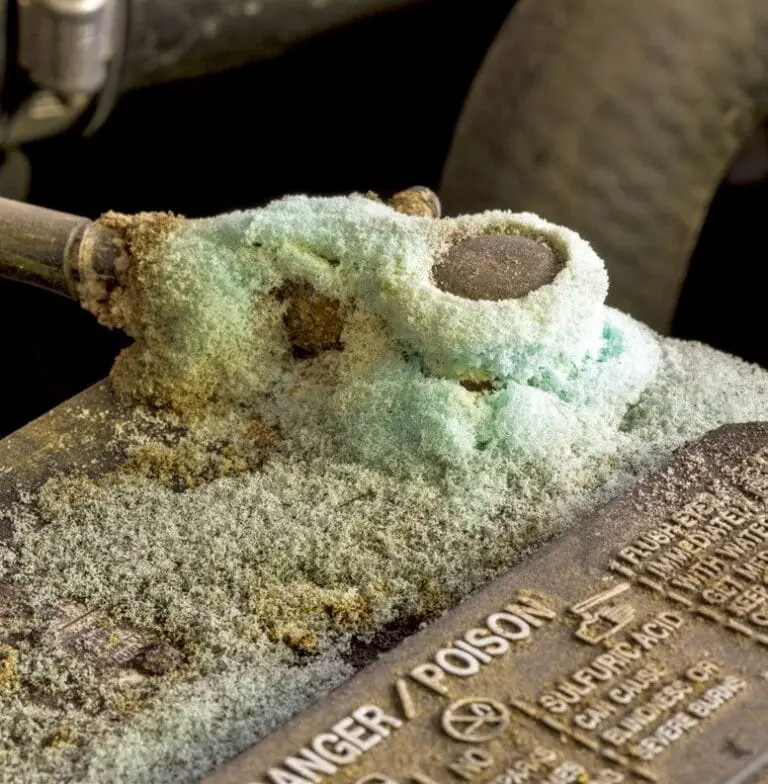
For example, as part of regular maintenance, lead-acid batteries require watering, equalization charges and if any corrosion is present, it must be cleaned off, too. Lithium-ion batteries, on the other hand, lack routine maintenance that operations already stretched to find labor may find appealing.


Operating temperature
Do trucks operate at mild or somewhat cool temperatures? What about something more extreme, like a refrigerated or hot environment? Or, maybe your operation encompasses both ends of the hot and cold spectrum?
Some power sources cannot handle the extremes. For example, in frozen environments or outdoors in the cold of winters, lead-acid batteries struggle, performing much less efficiently than in ideal conditions. Their lithium-ion and internal combustion engine counterparts, however, stay relatively consistent through a wide range of temperatures.
Temperature is a critical factor to dictate best-fit power sources, and could even drive some operations to consider more than one, with certain power sources leveraged to their best extent in specific parts of the operation.
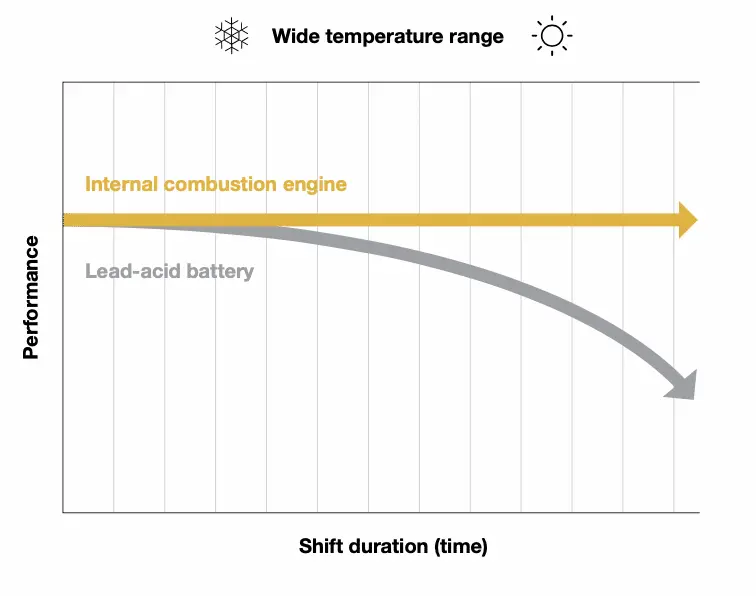
Depending on operating temperature, power source performance can remain steady or decline over time.

Space constraints
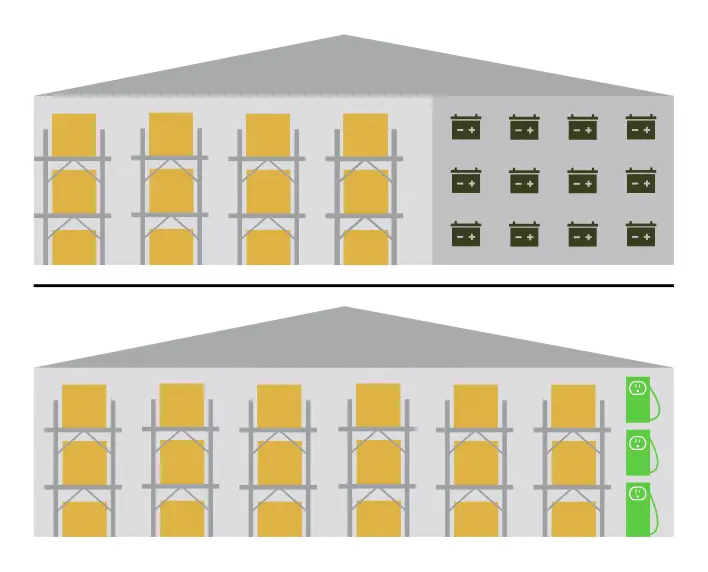
SKU proliferation pushes warehouse capacity to the max, and rising land costs drive facility managers to reexamine how current space is used before entertaining costly new construction. Limiting the footprint of a lift truck fleet—including charging and fueling infrastructure, battery storage and idle trucks can take back valuable square footage for revenue-generating activities.
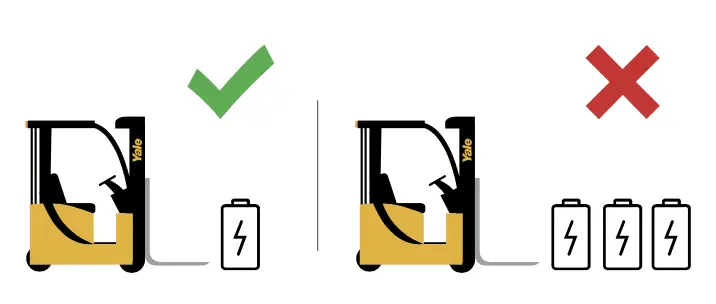
To assess the burden of a power source on limited facility space, start with the power source to lift truck ratio. If a power source requires two or more power sources per truck, it means redundant equipment may be creeping into otherwise usable space. This can happen with lead-acid battery packs but also liquified petroleum tanks for internal combustion engines. Two or more tanks or battery packs per truck add up quickly, occupying additional valuable space.

Labor availability
Record low unemployment means operations must make the most of scarce labor resources, but complex battery maintenance, charging and replacement processes can take a bite out of worker productivity.
While less demanding than lead-acid, lithium-ion batteries still require operators to pay attention to charge level and take advantage of opportunity charging to maximize efficiency. Internal combustion engines and hydrogen fuel cells offer the simplest refueling alternative. Any scheduled maintenance can be handled by dedicated technical resources, allowing operators to focus on their core job.


Electrical grid dependence
Many markets have a dependable electric grid, but some rural areas can suffer from insufficient capacity that could require costly upgrades, while urban centers can fall victim to ‘brown-outs.’ Another factor is the risk of increased utility rates during peak hours.
Operations can avoid this by staggering charging schedules to avoid overtaxing electrical grids during peak times. But both internal combustion engines and hydrogen fuel cells offer opportunities to store fuel on-site, minimizing dependency on public utilities to a greater extent than any other option.

Emissions
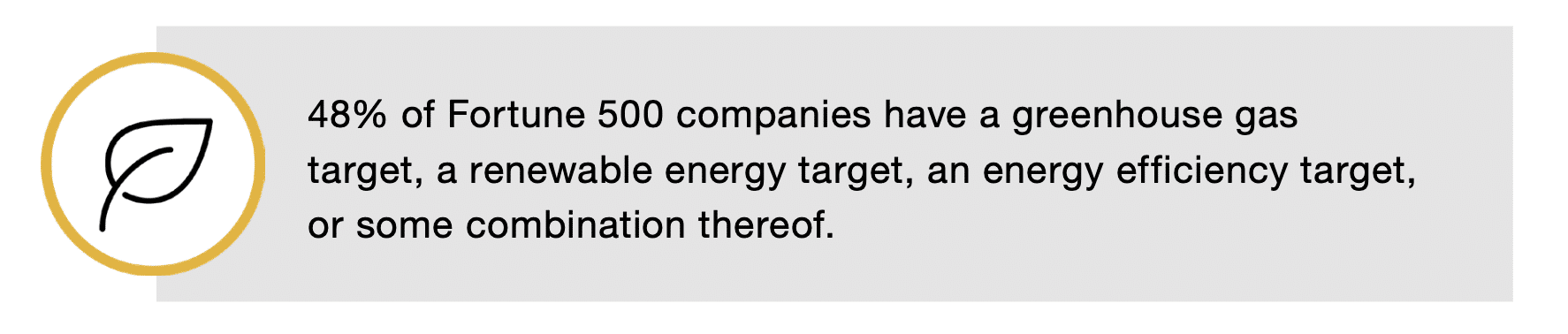
Whether due to government regulations, strict standards for general hygiene and airborne pollutants, or corporate sustainability initiatives, operations face myriad pressures to reduce emissions and use the cleanest power sources possible. To understand your tolerance for emissions, consider the following questions:
- Is your application outdoors or indoors?
- Does your facility have strong ventilation with large, open spaces?
- Do lift trucks work in clean environments subject to hygiene standards?
- Are you subject to emissions reduction mandates by sustainability initiatives?
All of these factors come together to dictate a power choice that maintains performance while avoiding fines and other sanctions. For example, lithium-ion batteries and hydrogen fuel cells generate zero harmful emissions and are suitable for indoor operations and industries like food and pharmaceuticals. And while internal combustion engines clearly produce emissions, lead-acid batteries also emit gases during charging and sometimes leak corrosive chemicals if not properly maintained.
Power up the right option
Ultimately, maximizing efficiency is the overall goal and prioritizing three key principals can set operations up for success:
|
||
|
||
|
Together, these ideals keep lift truck fleet operation simple, enabling easier scalability and day-to-day management.

To make the right lift truck power choice, understand your operation’s requirements for the factors above and bring in the experts. The Riekes team offers the industry’s broadest range of power options and the expertise to match operations with the best-fit power solution based on their specific application.