
Winter Install Nearly Doubles Lift Capacity at Concrete Building Manufacturer Worksite
Partnerships built on shared goals, consistent service and a history of solving complex material handling challenges tend to be long lasting. A decade ago, a precast concrete building manufacturer based in South Dakota partnered with Riekes Equipment to purchase their first Combilift straddle carrier to support increasing production demands. At the time, that unit met their needs and helped boost efficiency across their facility.
Over time, the company’s business continued to grow. They began producing larger, heavier, precast concrete buildings to meet increasing customer demands. As the size and weight of these structures increased, so did the strain on their equipment. Their original straddle carrier could no longer handle the loads safely or effectively.
During a service call, the Riekes technician noticed that the current carrier was being pushed to its limit. Recognizing the risk to both workflow and safety, they brought the issue to the attention of the broader Riekes team. Thanks to that early observation, the customer avoided a potential equipment failure and instead, gained a chance to safely upgrade.
INITIAL CHALLENGE
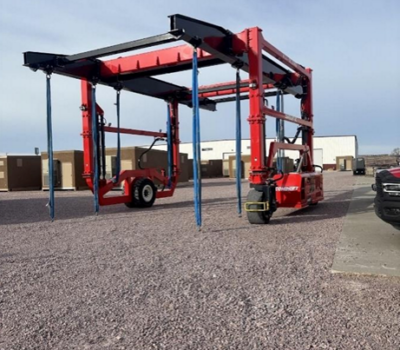
The main issue centered around capacity and space. The customer’s existing Combilift straddle carrier had a lift limit of 70,000 pounds. However, the newer precast buildings weighed up to 120,000 pounds, far beyond what the original unit could handle. The difference in load capacity made it impossible for the old machine to keep up with production demands, slowing operations and raising concerns about safety and reliability.
While a higher capacity unit was clearly needed, the facility layout posed another challenge. The new equipment had to fit within the same footprint as the older model. Space was tight, and any increase in size could disrupt traffic flow, limit movement, or require costly changes to the site layout. The customer needed a machine that was significantly stronger but physically no larger, a tough combination that ruled out most standard options. They also wanted to avoid a long downtime. With ongoing production, the transition to a new carrier had to be seamless, well-timed, and handled by a team that understood their environment and could deliver under pressure.
OUR SOLUTION
The Riekes team took action, holding several meetings with the customer to clearly define the requirements. Once the need for higher capacity and limited space was confirmed, Riekes reached out directly to the Combilift Engineers to see if a custom solution could be developed. The answer was yes. A new 3-wheel straddle carrier was built to match the exact dimensions of the customer’s current machine but with an increased lift capacity of 120,000 pounds. Now the lift could handle the heavier loads without taking up additional room. One notable change was the removal of the operator cab. Instead, the new carrier operated completely by remote control, giving the operator full visibility and control from a safe distance.
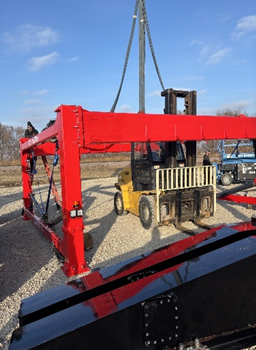
To prepare for the install, the Riekes Team worked closely with the customer on logistics and site planning. The installation process was complex and required heavy equipment to safely assemble the unit. Over four days, the team used two rental forklifts rated 8,000 pounds each, two all-terrain scissor lifts and a crane in order to position and secure the components. While the physical work was challenging, the coordination behind the scenes was just as important. Riekes handled scheduling, equipment rentals and communication with the customer every step of the way to ensure that no detail was missed.
THE RESULTS
The installation took place the week before Christmas in 2024, during a South Dakota winter. Conditions were tough; the warmest day only reached 25 degrees. Freezing temperatures added complexity to every part of the job. Despite the harsh environment, the Riekes Team stayed focused, followed the plan and completed the install without delay. By the end of the week, the new Combilift SC3 straddle carrier was fully assembled and operational. It met the customer’s load requirements and went live in the customer’s environment without disruption. The remote-control feature also gave operators more flexibility and improved safety during use.
The benefits were immediate. The new carrier improved efficiency, increased safety and gave the customer more confidence in their equipment. With the project successfully completed, the customer quickly placed an order for a second unit to be installed at another one of their locations the following month. From identifying the challenge to completing the install under harsh conditions, the team delivered a high-value solution that supported long-term success. It showed that even in extreme weather and tight timelines, Riekes could deliver dependable results, on time, on budget and without compromise.