The Right Equipment Improves Safety and Productivity
A Midwest manufacturing company was having challenges with its existing fleet of forklifts. Day-to-day operations were slowed by equipment failures, load damage and safety concerns that continued to pile up without the needed support from their current vendor. Frustrated with declining performance, the company was ready for a change.
That’s when Riekes Equipment stepped in and performed a walkthrough of their operations and identified several inefficiencies. It quickly became clear that the equipment being used wasn’t suited for the type of loads being handled. There was an opportunity not only to replace aging forklifts, but also to introduce a safer, more efficient system designed around the customer’s specific materials that would help get their quality products out on time.
INITIAL CHALLENGE
The customer's main challenge came from trying to move large, heavy panels with equipment that wasn’t designed for handling heavy loads. The forklifts had narrow carriages, but the loads, often set on large sheets of plywood, extended out past the forks causing it to be unstable and hard to control. Operators had to work harder to keep the loads from tipping or shifting, and that increased the chance of damage and operator injury. The oversized loads also put extra pressure on the forklifts, especially the mast and internal components, leading to more breakdowns and costly repairs.
Another concern was high operator turnover. New drivers were being properly trained but many didn’t have the experience to easily manage these awkward loads. This created even more safety risks and slowed down production. The company needed equipment that was easier to operate, less prone to failure and could handle a wide range of load sizes with more control.
OUR SOLUTION
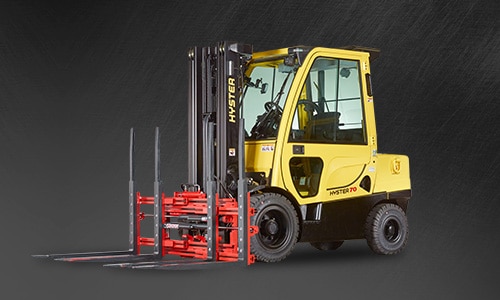
Riekes delivered a solution tailored to the exact demands of the facility recommending forklifts with wider carriage assemblies and integrated fork positioners. With a wider carriage, the forklift could better support the full width of the load. This reduced bowing, stopped shifting and created a more stable ride from pickup to drop-off. As a result, products were less likely to be damaged in transit, and operators felt more confident moving even the most awkward loads. The added control also meant less wear on the equipment, which helped lower maintenance needs over time.
Riekes provided an equipment demo to show how the upgraded equipment would perform in real-world conditions. This helped the operations team see the advantages for themselves and made it easier to get internal buy-in for the change.
THE RESULTS
The results were immediate and noticeable. The new forklifts gave operators a safer way to handle materials so product damage dropped significantly. The company also saw improvements in operator satisfaction. New drivers found the upgraded equipment easier to use, which helped with onboarding and reduced training time. With fewer interruptions and smoother material flow, overall productivity improved.
Because the loads were more stable during transport, operators could move quicker and with more confidence. There was also less mechanical strain on the forklifts, which lowered the frequency of breakdowns and cut down on the need for repairs. By pairing reliable equipment with consultative support, Riekes gave them a complete solution that solved real problems on the floor. Riekes didn’t just replace equipment, Riekes helped improve safety, performance and long-term confidence in how the customer handled their materials.