
How to Choose the Right Dock Leveler
Before selecting a dock leveler, one might be asking why they need one for their business. A dock leveler is an essential piece of equipment to make loading docks safer and protect cargo.
In most instances, the height of a dock and the truck that enters the loading area will be different, leaving a gap between the dock and the truck.
Dock levelers bridge that gap making it safer to load and unload materials.
There is a lot to consider when choosing dock equipment and the wrong equipment can put employees at risk. According to the National Safety Council around 25% of all reported warehouse injuries occur on loading docks as well as hundreds of near misses.
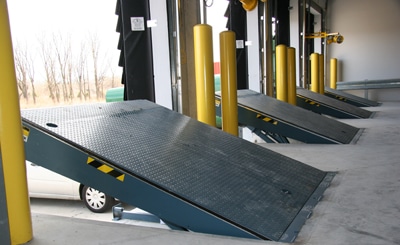
When loading and unloading, the leveler must be able to support various weight loads, compensate for the trailer’s up and down movements, and accommodate a wide range of trailers. Dock levelers have a ramp hinged along the rear edge, as well as the front of the ramp having a hinged lip. Most operations of the leveler are the same where the ramp is raised, the metal plate swings out and extends to lower onto the bed of the truck.
choosing the right leveler
With many levelers to choose from it is good to stop and determine your needs and what you need the leveler to do:
- What is the maximum load you will have? Don’t forget to count the weight of your forklift
- How often is the ramp used?
- What trailer heights do you need to accommodate?
- Do you have access to power?
- Is your business refrigerated?
- How much space do you have?
Learn more about dock service and equipment.
COMMON EQUIPMENT
Two most common types of levelers are pit and edge of dock.
Recessed (Pit) Dock Levelers provide the greatest service range. These are installed in pits formed by concrete during construction and either spring-loaded, mechanical action or powered push-button operation.
- Hydraulic Dock Levelers are a push-button controlled operation. These levelers have the lowest cost in ownership and the highest capacity rating.
- Air-Powered Dock Levelers are push-button controlled. They do not need electrical infrastructure and are an economical alternative to hydraulic levelers.
- Mechanical Dock Levelers are manually operated by chain pull, economical and durable for basic applications.
How would you choose between these three options? The comparison below shows the essential information for each type of leveler.
| Type | Ideal Traffic Load | Operation Type | Maintenance Schedule | Initial Cost | Power Source | Energy Efficiency |
| Hydraulic | Medium-Heavy | Automatic | Very Limited | High | Required | Moderate |
| Air-Powered | Medium | Semi-Automatic | Moderate | Moderate | Required | Moderate |
| Mechanical | Medium | Mechanical | Moderate | Low | Non- Required | Zero Consumption |
The second type of leveler is Edge-Of-Dock (EOD) whichare a lower-cost alternative, suited for applications with little variation in the truck bed and dock height. These are mounted to the face of the dock to eliminate the need to build a pit.
- Mechanical EOD Levelers are the easiest to use in industry with a two-step operation of an operating handle helping to eliminate personnel injuries and physical exertion. The leveler does not require electricity, instead it uses pullies and chains.
- Hydraulic EOD Levelers are push-button controlled for ease of operation of both raising, lowering, and extending of leveler, requiring minimal maintenance. The leveler is allowed to be raised and lowered with no physical effort.
THINGS TO NOTE
When choosing between these two remember that although the hydraulic EOD leveler costs more upfront, but over time, low maintenance makes it cost-effective. Also, the hydraulic leveler is ergonomic and easier to use over the mechanical EOD leveler.
There are also dock levelers used for specific facility applications. For example, vertical storing dock levelers are stored in the vertical position, completely inside the exterior door, allowing the door to form a seal to the pit floor. These are ideal for areas where high security or temperature control is a priority. Maintenance and adjustments can be done safely and unobstructed.
There is a lot to consider but designing the right dock will ensure that your productivity, safety, and quality control standards are met.
Need assistance in choosing the right dock leveler for your operations?
Give us a call at 800.856.0931 for a free site safety assessment!