Intelligent Lifting Devices: Boosting Warehouse Worker Productivity and Safety
The roi of Automation
Modern ergonomically assisted material handling is undergoing a dramatic transformation. One that is making repetitive-motion injuries and associated workers’ comp claims virtually obsolete. One that is drastically reducing, and even preventing, damage to products and fragile parts on the plant floor. One that is helping material handlers realize record-breaking levels of productivity and profitability. The technology behind the transformation: Intelligent Lifting Devices (ILDs).
Once the stuff of science fiction films, Intelligent Lifting Devices were first introduced to material handling in the late 1990s. Today, thanks to their impressive track record, ILDs are making their way into material-handling applications all over the world.
WHAT SETS INtelligent lifting device technology APART?
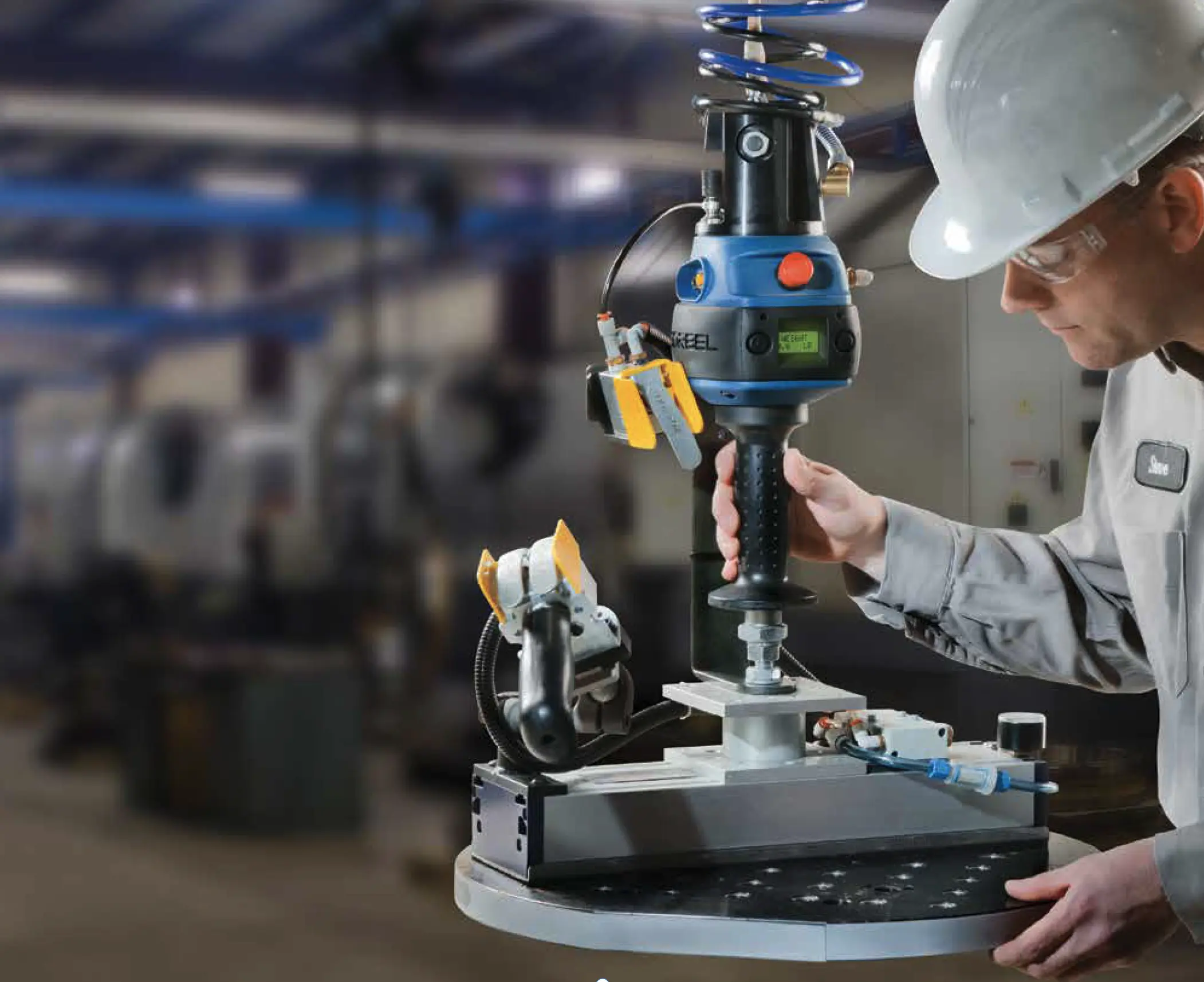
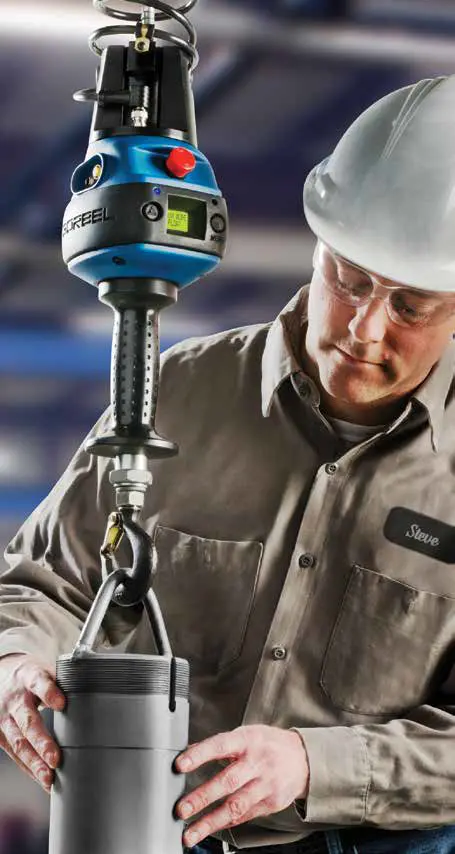
ILDs provide the best of both worlds: mixing the agility and responsiveness of a human operator with the power of a machine. They do this via a servo drive system, which amplifies control signals to power a motor at a rate equal to the signal it is receiving.
The result is a seamless execution in which operators can lift and maneuver loads up to 1,320 pounds naturally, without fatigue or injury.
- Mimic human motion
- High-speed servo control system
- Integrate with process and control systems
- Standard intelligence features
- Combine speed and precision
- Finger force guiding technology
- User-controlled slowdown points
The unmatched speed of ILDs
In any type of material-handling application, it’s all about productivity. The more cycles you can fit into a shift, the better. Not surprisingly, the push for productivity ultimately has led to more repetitive-motion and strain injuries, not to mention profit-draining workers’ compensation claims. Enter Intelligent Lifting Devices.
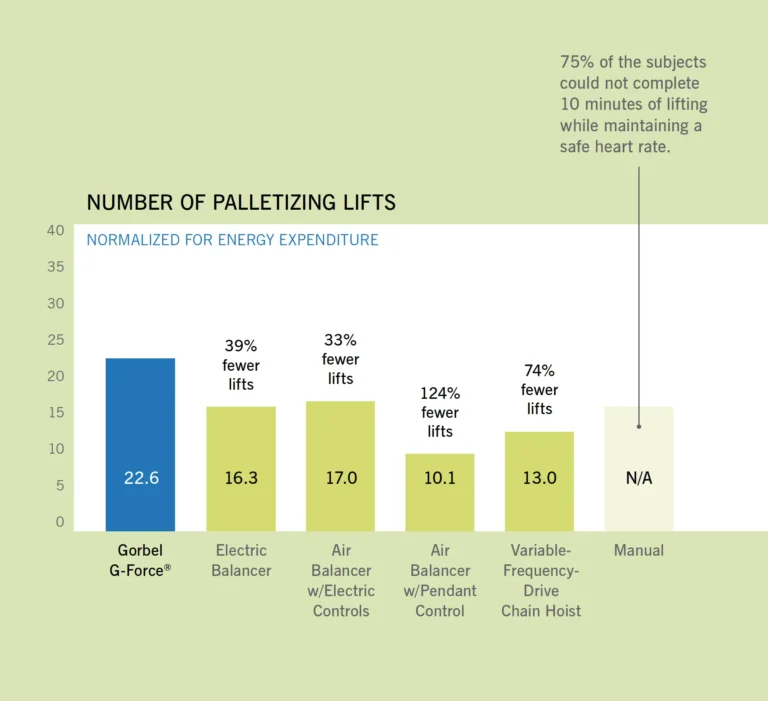
In a study conducted by the Rochester Institute of Technology, workers in high-cycle settings were nearly 70% more productive using Intelligent Lifting Devices than other lifting methods.
This increase in speed over other forms of lifting—including manual lifting, chain hoists, and air balancers—allows operators to work faster and maintain consistently higher levels of productivity without fatigue.
Where speed meets precision
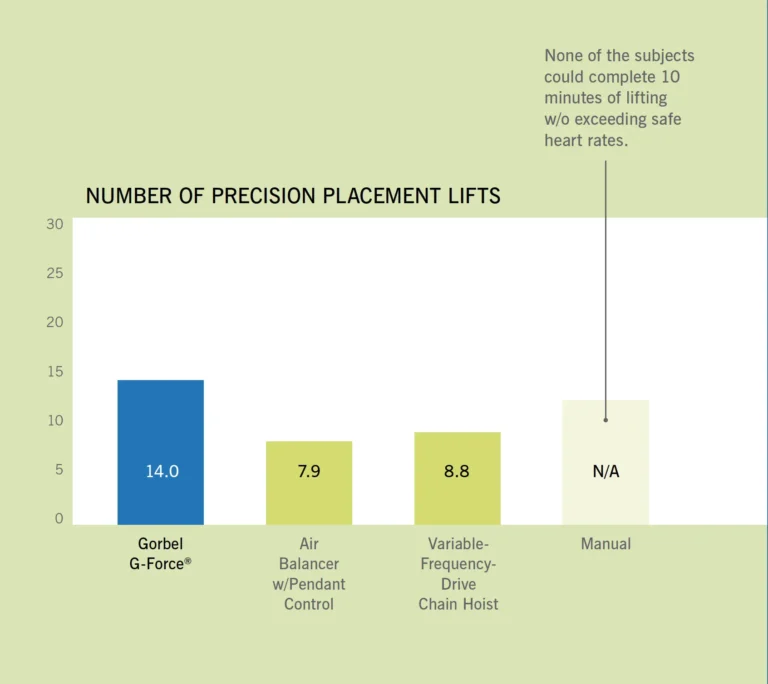
Intelligent Lifting Devices not only help operators move heavy loads faster without fatigue, but they also enhance precision placement as well. With the ability to move at infinitely variable speeds from 0 to 200 fpm, ILDs give operators the control they need to finesse expensive or fragile parts into place.
Using float mode, operators have the ability to precisely orient a load throughout the full stroke with as little as a 1/2 lb (227 g) of force on the load itself.
THE RESULT
ILDs can provide a dramatic uptick in efficiency and a huge reduction in product damage.
In fact, during precision placement tests, ILD operators were 77% more efficient than with air balancers, and 59% more efficient than with traditional hoists.
More precision means less product damage
ILDs boast two key features that dramatically reduce damage to products and fragile parts:
virtual limits
This mode allows the operator to set slowdown points so that movement is automatically smooth and slow at the point of placement. Virtual Limits also allow you to set hard upper and lower limits of a stroke in order to optimize the ergonomics of each operator and eliminate the potential for product damage.
float mode
With a mere 1/2 lb (227 g) of force on the load itself, operators can precisely orient loads throughout the full stroke range by manipulating the load with their hands.
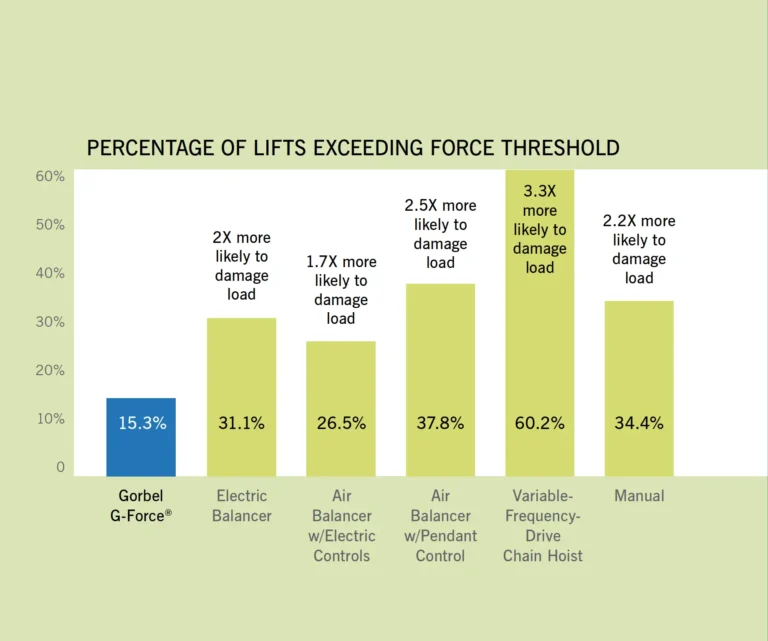
According to precision placement tests, the Virtual Limits and the Float Mode features make Gorbel’s G-Force® 3.3X less likely to damage a load than other lifting methods.
ILDs create a safer workplace
When you consider that about 60% of all injuries in manual material-handling environments are directly related to lifting and moving*, making the switch to ILDs makes solid financial sense. While the initial cost is higher than investing in non-ILD technologies such as hoists and balancers, the increase in productivity and reduction in injuries make it well worth the investment. In fact, a typical mid-size company can see a return on its investment in a matter of months.
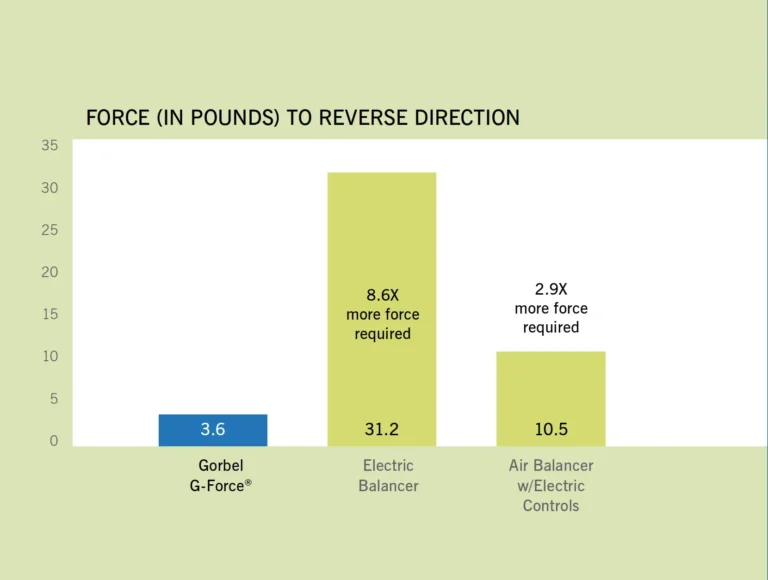
In addition to eliminating the constant O REVERSE DIRECTION bending, reaching, stooping, and twisting that lead to so many repetitive-motion injuries, G-Force® ILDs require the least amount of energy to operate. In inertia management studies, G-Force required an average of 5.8X less handling force than other devices, dramatically reducing injuries and their associated costs.
ILDs–an investment that keeps paying dividends
While the data here clearly shows ILDs are a great investment for material handlers, the benefits extend beyond productivity. For example, the ergonomic benefits of the technology improve worker morale, lower insurance costs, and reduce work stoppages, medical claims and absenteeism. Additionally, virtually anyone can operate an ILD efficiently—regardless of age, weight or gender. That means you can employ a broader workforce … and a more loyal one as well.
And that’s a great way to get bigger returns for your company’s bottom line.