ENGINEERING CONSULTATION Creates Possibility of OVERHEAD CRANE SYSTEM
Specializing in building steel components, a Nebraska metal fabrication company found that they needed smarter ways to handle heavy and awkward materials. Years earlier, they had partnered with Riekes Equipment to install cranes over their robotic welding cells. That system improved operations and built trust. So, when they added a semi-automated cut-saw machine and new welding bays, they reached out to Riekes again to help design a solution that would improve workflow, reduce safety risks and support long-term growth.
INITIAL CHALLENGE
The customer’s operations had grown more complex, but their method for moving materials hadn’t changed. They still relied on forklifts to unload raw materials, move in-process items and carry finished parts out of production. Each time a truck came in or out, the entire shop had to stop. Especially since they were often carrying 24-foot-long steel components.
OUR SOLUTION
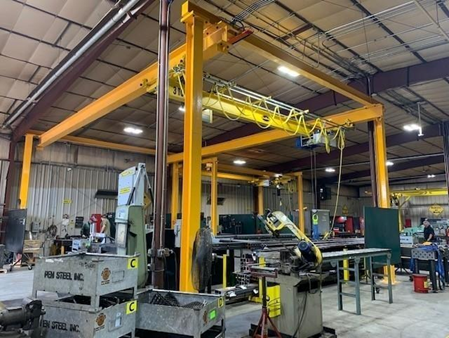
Riekes worked closely with the customer to engineer a new overhead lifting system that could solve these challenges. The goal was to eliminate forklift use inside the production floor and reduce the amount of physical labor required to handle materials. Our Hoist and Crane Team provided detailed layout drawings and engineering documentation. With those resources, the customer fabricated their own support structure, cutting costs and gaining full control over the timing and build quality.
The crane system was positioned overhead to serve three key stations, the CNC computerized saw and both welding bays. This made it possible to load raw materials directly into the saw, move components between workstations and unload finished product - all without disrupting nearby processes. Forklifts were no longer needed to drive through production space and loads could now be moved safely overhead. The remote-controlled crane required just two people to operate, cutting labor demands and removing the need for workers to manually lift large parts.
THE RESULTS
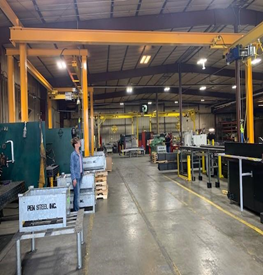
The benefit was immediate. Welders no longer had to stop working to wait for materials or worry about forklifts interrupting their stations. The new crane system provided a consistent, reliable material flow, which boosted efficiency and reduced downtime. The work environment also became much safer. Without forklifts moving through the middle of the floor or workers lifting heavy steel manually, the risk of accidents dropped significantly.
By using Riekes's engineering plans to fabricate their own support system, the customer saved time and money while staying on schedule. The result was a streamlined layout tailored to how they worked, allowing raw materials to come in, move through production and leave the shop floor with minimal handling.
As one team member put it, “It’s a night and day difference since our team doesn’t have to stop working and wait for materials to be handled.” The solution didn’t just improve operations, it reshaped how the company approached growth, giving them a safer, faster and more sustainable path forward.